 Klyvora
AI inference is no longer limited to cloud data centers. Hospitals, factories, research labs, and retail operations increasingly run models closer to their users and data. That shift makes server choice a practical engineering decision. A capable ai inference server manufacturer must balance accelerator performance with memory, networking, cooling, power use, and support. Peak compute figures alone rarely tell the whole story.
This guide examines ten manufacturers often considered for inference deployments, including established enterprise vendors and specialists in accelerated computing. The list is a starting point, not a universal ranking. Product availability, regional support, and workload requirements can change the fit. Details matter. A server handling image analysis may need different accelerators and memory capacity from one serving a language model. Buyers should compare validated configurations, warranty terms, software compatibility, and realistic performance data—not just headline specifications. A dense rack can look impressive on paper, yet create cooling or power challenges in a smaller facility. Not always obvious. Manufacturer claims also deserve context: published results may rely on specific models, software versions, and test conditions. Where evidence is limited, that uncertainty should be stated rather than hidden. The sections ahead compare vendors by their product strengths and deployment considerations, helping readers build a shortlist that matches real workloads. The final choice still depends on careful testing.
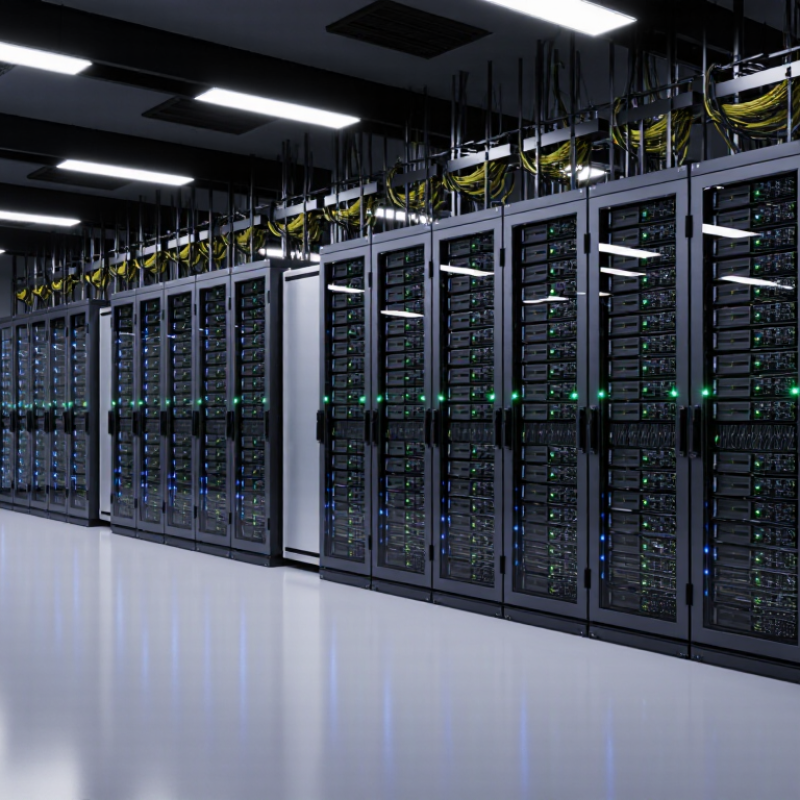
An AI inference server is a computer system that uses a trained model to produce results from new data. It might classify a photograph, transcribe a spoken request, or generate a response to a user. The model is already trained; the server handles the live calculations. That distinction matters. Training often involves large, repeated workloads, while inference must respond reliably as requests arrive.
Inside the server, processors or accelerators perform model calculations, while memory holds model data and active requests. A busy service may need several accelerators, but smaller workloads can run on simpler hardware. For example, a server inspecting product images may need to process each image quickly without building a long queue. Memory matters, too. If the model does not fit efficiently, performance can suffer. Network delays and power use also shape the design. There is no perfect configuration. Benchmarks should reflect real input sizes and traffic, not just impressive peak speeds. The boundary between inference and other computing tasks can be less tidy in practice. That is worth checking.
An AI inference server runs trained models to generate predictions or responses. The anonymized profiles below summarize representative server configurations available in the market; they are not a verified manufacturer ranking, and company and brand names are omitted.
| Anonymous Profile | Typical Form Factor | Accelerator Capacity | Host CPU Configuration | System Memory | Networking | Common Inference Use |
|---|---|---|---|---|---|---|
| Profile 01 | 1U rack server | 1–2 PCIe accelerators | 1–2 server CPUs | Up to about 2 TB | 10–100 GbE options | Compact, low-latency services and small models |
| Profile 02 | 2U rack server | 2–4 PCIe accelerators | 1–2 server CPUs | Up to about 4 TB | 25–200 GbE options | Vision inference and multi-model applications |
| Profile 03 | 4U GPU server | 4–8 PCIe accelerators | 2 server CPUs | About 1–8 TB | 100–400 GbE or InfiniBand options | Large language models and high-throughput serving |
| Profile 04 | 5U–6U accelerator server | Up to 8 high-power accelerators | 2 server CPUs | About 2–8 TB | 200–400 Gb/s fabric options | High-density generative AI inference |
| Profile 05 | 4U liquid-cooled server | Up to 8 liquid-cooled accelerators | 2 server CPUs | About 2–8 TB | 100–400 Gb/s fabric options | Dense deployments with substantial accelerator power draw |
| Profile 06 | 4U multi-GPU server | 4–8 accelerators with high-speed interconnect options | 2 server CPUs | About 1–4 TB | 200–400 Gb/s fabric options | Low-latency serving of larger models across accelerators |
| Profile 07 | 2U edge server | 1–2 compact accelerators | 1 server CPU | About 128 GB–1 TB | 1–25 GbE options | Retail, industrial, and branch-site inference |
| Profile 08 | 4U modular server | Up to 8 PCIe accelerators | 1–2 server CPUs | Up to about 4 TB | 25–200 GbE options | Flexible deployments with mixed accelerator workloads |
| Profile 09 | 8U scale-up system | Up to 8 tightly interconnected accelerators | 2 server CPUs | About 2–8 TB | High-speed accelerator fabric and 100–400 Gb/s networking | Large-model serving requiring fast accelerator-to-accelerator communication |
| Profile 10 | 2U CPU-focused server | Optional 1–2 inference accelerators | 1–2 server CPUs | About 256 GB–4 TB | 10–100 GbE options | CPU inference, preprocessing, and cost-sensitive mixed workloads |
Specifications vary by configuration. Accelerator count, memory capacity, networking, and cooling should be checked against the selected system’s official product documentation.
Compare throughput, latency, accuracy, power use, and serviceability. Peak performance alone can mislead.
Match the model, precision, batch size, and test conditions. Different settings can produce very different results. Numbers need context.
Run your own model with typical request sizes. Track p95 latency, power use, and failures for several hours. Real traffic can be messy.
No. Performance varies by workload, region, and hardware generation. Treat rankings as a starting point, not a final verdict.
Specify model size, request volume, latency targets, and expected growth. Test representative prompts and input lengths.
Check memory capacity, bandwidth, networking, and cooling. A fast processor may sit idle while waiting for data.
Confirm spare-part availability, firmware updates, warranty coverage, and written support response times. Check rack depth and airflow, too.
Include electricity, cooling, deployment, and service costs. Ask what each test excluded. The best choice may still be unclear.
An AI inference server is a computing platform designed to run trained AI models and deliver predictions or generated responses efficiently. This overview explains how manufacturers can be evaluated, including their hardware capabilities, support for accelerators, performance, scalability, energy efficiency, software compatibility, and technical assistance. It also introduces the kinds of providers considered among the top 10 AI inference server manufacturers, without treating a single ranking as suitable for every organization.
Inference server platforms differ in how they balance throughput, latency, workload flexibility, and operating costs. Buyers should begin by identifying the models they plan to run, expected user demand, deployment environment, and future growth needs. They can then compare system configurations, integration requirements, reliability, and service options against those priorities. Choosing an ai inference server manufacturer that aligns with both current workloads and long-term plans can help organizations build an inference environment that is effective, adaptable, and practical to maintain.
