 Klyvora
A data center ai server manufacturer is more than a company assembling racks with powerful processors. It designs, validates, and supports computing systems built for demanding artificial intelligence workloads. These systems may combine GPUs, CPUs, high-speed memory, specialized networking, storage, and advanced cooling. Every component must work reliably under sustained load.
The work becomes visible in practical details. Engineers test thermal performance inside dense racks, measure power consumption, and check GPU communication across multiple nodes. They also manage firmware, driver compatibility, remote monitoring, and replacement procedures. A dependable manufacturer provides documented test results, clear warranty terms, spare-parts planning, and technical support that remains available after installation. Details matter.
Experience often separates a capable supplier from a simple hardware reseller. Engineers who have handled overheating alarms, failed network links, or delayed component deliveries understand operational pressure. They can recommend air cooling, liquid cooling, or a hybrid design based on workload and facility limits. The answer is practical.
However, no manufacturer is perfect. A system with impressive benchmark scores may still create difficult service demands or unexpected energy costs. Brochures rarely show every limitation. Buyers should question performance claims, request independent validation, and examine deployment references. This definition is not complete without accountability.
Understanding what a data center ai server manufacturer does helps organizations compare vendors more carefully. It also connects technical specifications with real business outcomes, including uptime, training speed, operating cost, and future expansion. The strongest partner delivers tested hardware, honest guidance, and measurable support throughout the server’s working life.
What Is a Data Center AI Server Manufacturer?
A data center AI server manufacturer designs and builds computing systems for demanding artificial intelligence workloads. Its role extends beyond assembling processors, memory, storage, and network cards. The manufacturer must balance performance, reliability, energy use, and long-term maintenance.
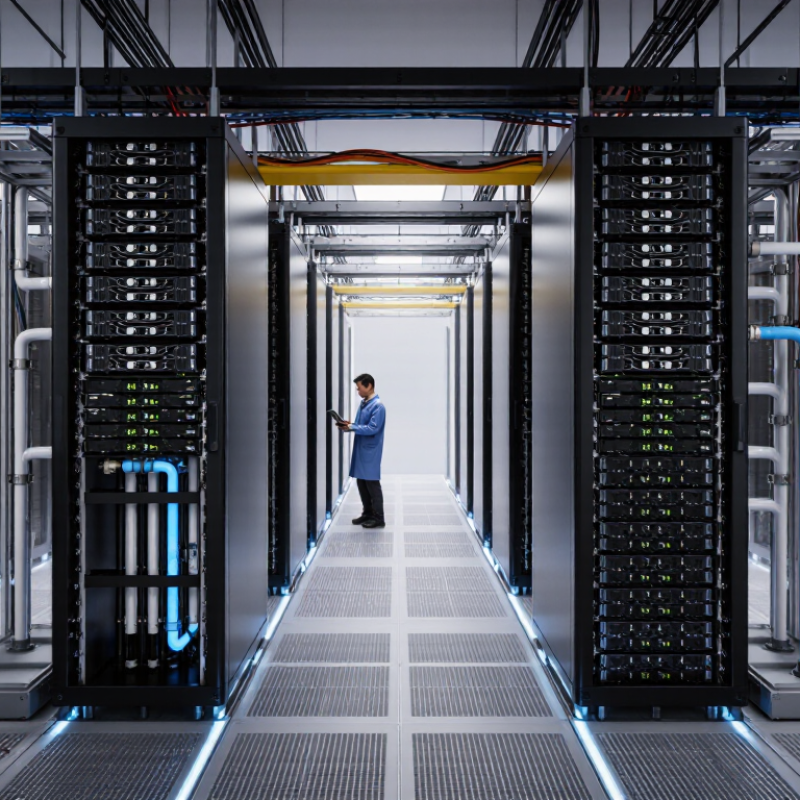
In practice, engineers test servers with sustained model training, high-speed data transfers, and continuous workloads. They also design airflow paths, liquid or air cooling, power delivery, and remote monitoring tools. A reliable manufacturer validates firmware, checks component compatibility, and documents repair procedures. These details matter when a server operates inside a crowded rack for years. A rushed specification may look impressive but fail under heat or unstable power. No design is perfect. Engineers must keep reviewing results.
Tips: Ask for thermal test data, workload benchmarks, warranty terms, and replacement timelines. Confirm whether the system supports your software environment before purchase. Check service access too. A difficult repair can increase downtime and labor costs.
The manufacturer also acts as a technical partner during deployment. It may help plan rack layouts, network capacity, cooling requirements, and security controls. Strong support includes clear escalation channels and practical troubleshooting guides. However, buyers should not accept every performance claim without evidence. Independent testing and transparent documentation provide stronger confidence than marketing language. The best evaluation considers the complete lifecycle, from installation to upgrades and eventual retirement.
| Data Dimension | Definition | Typical Role of the Manufacturer | Relevant Evaluation Criteria |
|---|---|---|---|
| Industry Definition | A data center AI server manufacturer designs, integrates, validates, and supports computing systems optimized for artificial intelligence workloads. | Provides purpose-built infrastructure for model training, fine-tuning, inference, data processing, and high-performance computing. | Engineering capability, product reliability, workload fit, and long-term support. |
| Primary AI Workloads | AI servers are commonly used for deep learning, machine learning, generative AI, computer vision, natural language processing, and scientific computing. | Configures systems according to the processing, memory, storage, networking, and software requirements of each workload. | Training throughput, inference latency, scalability, utilization, and compatibility with AI frameworks. |
| Accelerator Integration | AI servers may incorporate GPUs, dedicated AI accelerators, or other parallel-processing devices in addition to general-purpose CPUs. | Designs the server around accelerator quantity, interconnect topology, power requirements, cooling needs, and workload communication patterns. | Accelerator density, memory capacity, interconnect bandwidth, thermal headroom, and serviceability. |
| CPU and System Architecture | The CPU manages operating-system functions, data preparation, orchestration, input and output operations, and tasks that are not handled by accelerators. | Selects processors, chipsets, memory architecture, expansion slots, and system layouts that prevent bottlenecks around the accelerators. | Core count, memory channels, PCIe support, NUMA design, workload balance, and upgrade flexibility. |
| Memory Configuration | System memory stores operating-system processes, datasets, preprocessing workloads, and intermediate results during AI operations. | Balances capacity, speed, error protection, and expansion options with the requirements of the target AI workload. | Capacity, memory bandwidth, error-correcting capability, channel utilization, and expansion capacity. |
| Storage Architecture | AI infrastructure often uses high-speed storage for datasets, checkpoints, model files, logs, and temporary processing data. | Integrates storage controllers, solid-state storage, local data paths, and support for shared or networked storage environments. | Sequential and random performance, capacity, endurance, data protection, and ease of replacement. |
| High-Speed Networking | Distributed AI systems rely on fast, low-latency communication between servers, storage systems, and management networks. | Provides network interfaces and system layouts that support cluster communication, data movement, remote management, and storage access. | Bandwidth, latency, port density, topology support, congestion control, and interoperability. |
| Thermal Management | AI servers can produce substantial heat because accelerators and processors operate at high utilization for extended periods. | Engineers airflow, heat sinks, fans, chassis layouts, power delivery, and, where appropriate, liquid-cooling options. | Cooling capacity, operating temperature, acoustic profile, airflow efficiency, and maintenance requirements. |
| Power Design | AI systems require stable power delivery for processors, accelerators, memory, storage, fans, and networking components. | Specifies power supplies, redundancy options, power distribution, monitoring functions, and energy-management features. | Rated output, redundancy, efficiency, peak-load handling, monitoring, and data-center power compatibility. |
| Server Form Factor | Common formats include rack-mounted systems and specialized high-density platforms designed for data-center deployment. | Optimizes internal layout, component density, rack compatibility, cable management, airflow, and access for maintenance. | Rack compatibility, density, expansion space, service access, airflow direction, and deployment constraints. |
| Software Compatibility | AI servers must work with operating systems, drivers, container platforms, orchestration tools, libraries, and model-development frameworks. | Performs hardware validation, publishes configuration guidance, and helps ensure consistent operation across the software stack. | Driver stability, framework support, firmware coordination, container compatibility, and update procedures. |
| Cluster Scalability | Organizations may connect multiple AI servers to create clusters for larger models, higher throughput, or distributed training. | Designs scalable configurations and provides guidance for networking, rack deployment, synchronization, storage, and cluster management. | Node consistency, interconnect performance, expansion process, workload scheduling, and operational efficiency. |
| Reliability and Availability | Data-center systems are expected to operate continuously and minimize service interruptions caused by component failures. | Uses validated components, redundant subsystems, diagnostic tools, monitoring features, and documented service procedures. | Mean time between failures, component redundancy, fault detection, spare-parts availability, and maintenance design. |
| Security Features | AI servers process valuable data and models, making hardware, firmware, access control, and secure data handling important. | Implements secure boot capabilities, firmware controls, identity management support, data protection options, and security documentation. | Firmware protection, access control, encryption support, auditability, vulnerability response, and secure decommissioning. |
| Validation and Testing | Validation confirms that hardware, firmware, drivers, cooling, power, and software operate correctly under expected workloads. | Conducts compatibility testing, stress testing, thermal testing, performance benchmarking, and system-level qualification. | Test coverage, repeatability, workload relevance, documentation quality, and issue-resolution process. |
| Deployment Services | Deployment includes installation, configuration, network integration, software setup, and preparation for production use. | May provide rack integration, imaging, cluster configuration, acceptance testing, documentation, and technical training. | Implementation time, installation accuracy, integration support, documentation, and knowledge transfer. |
| Technical Support | Support helps operators diagnose hardware, firmware, driver, thermal, power, and performance issues throughout the system lifecycle. | Offers troubleshooting, firmware updates, replacement services, escalation procedures, and technical documentation. | Response time, service coverage, diagnostic capability, spare-parts logistics, and escalation quality. |
| Total Cost of Ownership | The total cost includes acquisition, electricity, cooling, software, maintenance, upgrades, downtime, and eventual disposal. | Helps customers choose configurations that balance performance, energy use, capacity, reliability, and future expansion. | Performance per watt, utilization, maintenance cost, upgrade path, warranty terms, and expected service life. |
| Environmental Considerations | AI infrastructure can have significant energy and cooling requirements, so efficient design is important for responsible data-center operation. | Improves power efficiency, airflow, cooling compatibility, component longevity, packaging, and end-of-life processes. | Energy efficiency, cooling efficiency, material use, repairability, recycling options, and environmental reporting. |
| Manufacturer’s Core Value | The manufacturer connects advanced computing components with a reliable, supportable, and deployable data-center platform. | Transforms individual components into validated systems that deliver predictable AI performance at operational scale. | Product consistency, engineering depth, lifecycle support, integration quality, and ability to meet specific workload requirements. |
It designs complete systems for model training, inference, and data processing. Core parts include accelerators, processors, memory, storage, networking, power supplies, and cooling. Every part must meet electrical and thermal limits.
Start with workload analysis, not attractive specifications. Training needs high memory bandwidth and fast interconnects. Inference often values low latency and energy efficiency. The best choice depends on actual data movement.
Dense computing creates substantial heat inside racks. Air cooling suits moderate loads. Direct liquid cooling supports higher density. Ask for test results from complete rack configurations, not only isolated hardware.
Production may include circuit-board assembly, firmware installation, chassis integration, and cable validation. Engineers should run sustained burn-in tests. They check voltage, fans, networking, and thermal behavior.
Request records for burn-in testing, component traceability, and failure handling. Check firmware control and recovery procedures. A reliable design should explain problems clearly. Perfect claims deserve caution.
Measure training time, inference latency, power draw, noise, and recovery after component failure. Observe airflow around real racks. A pilot reveals details that a datasheet may hide.
Results can change with software versions, datasets, and cooling conditions. Peak scores may hide poor memory balance or slow networking. Real workloads matter more. Benchmarks are useful, but incomplete.
Ask about replacement-part speed and engineering support. Remote assistance may be enough for some deployments. Others need on-site help. Support quality is difficult to measure before trouble starts. That is the uncomfortable part.
Electricity and cooling can dominate long-term costs. Large facilities may face power availability limits. Skilled staff also remain important for maintenance and recovery. Hardware alone cannot guarantee stable operation.
A data center ai server manufacturer is a specialized company that designs, builds, and delivers high-performance servers for artificial intelligence workloads. Its role includes integrating powerful processors, accelerators, memory, storage, networking, cooling, and power systems to support tasks such as model training, inference, data analysis, and virtualization. Core technologies may include GPU or other AI accelerator integration, high-speed interconnects, liquid or advanced air cooling, intelligent power management, and secure server management software.
AI server production typically involves workload analysis, hardware design, prototype testing, component validation, system assembly, firmware configuration, and quality inspection. Beyond hardware, manufacturers may provide infrastructure planning, deployment support, maintenance, monitoring, system optimization, and customized solutions for different data center environments. When evaluating a manufacturer, organizations should consider technical expertise, product scalability, reliability, energy efficiency, compatibility, security, testing standards, delivery capabilities, warranty coverage, and long-term technical support. A strong partner should offer transparent specifications and solutions aligned with operational goals and future growth.
